Authored by Aditi Tiwari, a 5th-year law student at National University of Study and Research in Law (NUSRL), Ranchi
Introduction
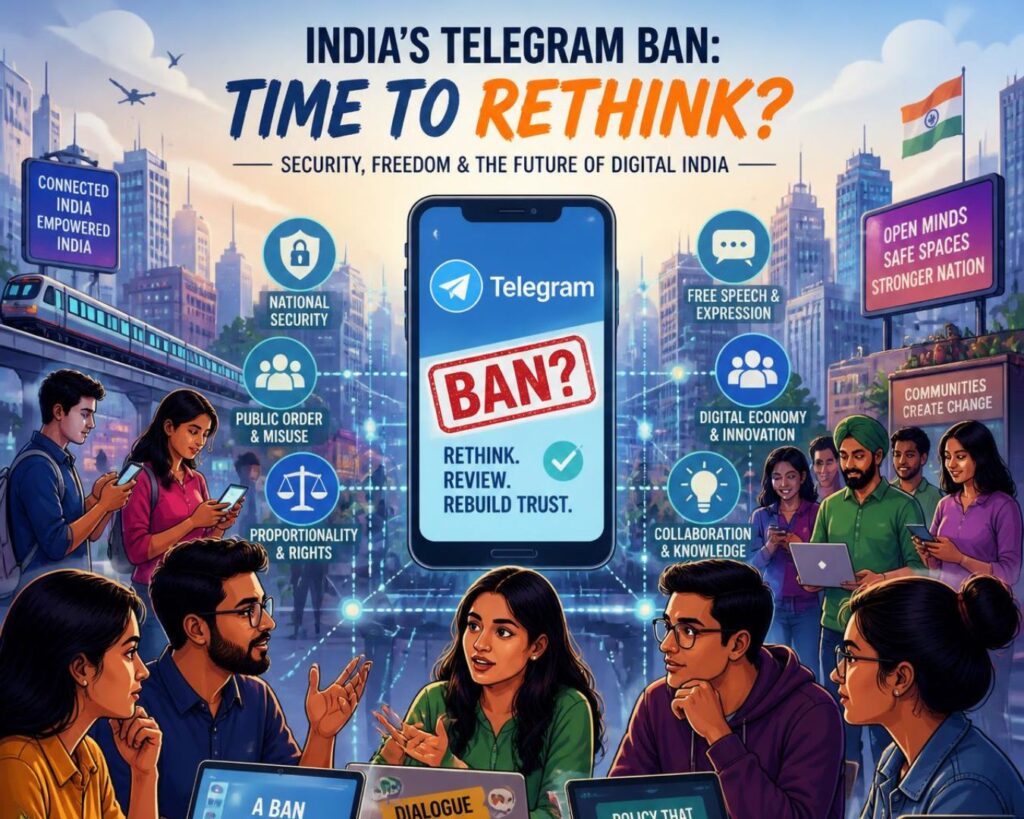
The Government of India’s temporary blocking of Telegram before the NEET-UG 2026 re-examination has revived a constitutional and regulatory quandary that has existed for decades. Can the State legally ban an entire digital platform to prevent examination fraud? The restriction, it is reported, was done under Section 69A of the Information Technology Act, 2000, on the premise that the organised cheating gangs were exploiting Telegram to send leaked question papers, spread misinformation and alter evidence through editing. The decision is certainly a significant development from a state interest standpoint, as it seeks to defend the integrity of one of India’s most important competitive exams, but it has ramifications for intermediary liability, proportionality, and digital governance.
This article suggests that the Telegram ban is part of the trend of entrusting enforcement to the platform and not the institution. While the government may have temporarily disrupted fraudulent networks, it will not necessarily act as a framework for regulating encrypted communication platforms when it comes to the source of examination leaks. Rather, it may set a foundation for cases of convenient alternatives to poor administrative governments. The central issue is with Telegram. The platform is widely considered to be the root of cheating in exams. This is a misguided framing, legally and technically speaking.
Telegram acts as a mediator in the realm of communication. As with most digital platforms, it can provide a means for information exchange, but it cannot create the information itself. When examination papers are received by Telegram, the initial breach has taken place in the examination ecosystem, either through people inside the system, compromised examination logistics, or criminal groups.
The example of the NEET controversy illustrates this point. Numerous investigations and reports have shown that many Telegram channels claimed to have leaked papers, many of which proved to be fabricated or edited after inspection. Some channels took advantage of Telegram’s message-editing capabilities to post false questions as if they had been uploaded before the test, thereby creating “evidence” of leaks. Some students were exploited by selling bogus papers that caused the students to worry. But Telegram itself was not the cause of the fraud – it became the means to commit it. Consider the platform the cause of the misconduct rather than the medium, however, and you’re liable to make the medium the problem.
Intermediary Liability Cannot Become Absolute Liability
Information Technology law states that if a third party can fulfil certain requirements and follow government directives, they are provided a safe harbour. This approach is based on an important principle: that intermediaries play a role in enabling communication, but do not necessarily bear responsibility for all the unlawful acts of their users. The concept that intermediary liability is not absolute—often referred to as conditional immunity or “safe harbour”-is outlined in Section 79 of the IT Act.
The blocking of an entire platform is, however, not a simple case of intermediary regulation, as it is a temporary measure. The ban did not target specific illegal channels or accounts, but it included millions of users who were using Telegram for education, conducting business, developing software, researching, and professional networking.
It is a radical departure from content policing to platform suppression. This not only makes the internet insecure, but also any platform that can communicate over encryption – including WhatsApp, Signal and newer decentralised applications – will have the potential to be compromised at any time when illegal material is shared via them.
The result is a blurring of the lines between platform responsibility and platform culpability.
Constitutional Limits of Platform-Wide Blocking
While the examination of the integrity of examination cannot be the sole criterion for declaring the temporary ban on Telegram illegal, it also needs to be analysed with reference to the constitutional framework in India relating to intermediary liability and restrictions on online speech. A temporary blocking order was issued under Section 69A of the Information Technology Act, 2000 before the Delhi High Court in the case Telegram FZ LLC & Anr. v. Union of India & Ors. The case was decided on June 19, 2026. The Government justified this as an emergency step to prevent the leakage of NEET-UG 2026 re-examination papers on Telegram channels. The Delhi High Court refused to grant interim relief, and then upheld the temporary restriction, noting that the Government had followed the procedure as laid down in Section 69A, and that the imposition is not disproportionate since it was in “extraordinary circumstances and for a limited period of time”.
The Supreme Court in Shreya Singhal v. Union of India (2015) discussed the constitutionality of Section 69A. Though the Court declared Section 66A of the Information Technology Act as unconstitutional, it did uphold Section 69A as it has procedural safeguards such as providing reasons for blocking, the designated committee for reviewing and restricting it only on the ground mentioned under Article 19(2) of the Constitution. Blocking powers are exceptional; they are limited by statute and the Constitution.
In Anuradha Bhasin v. Union of India (2020), the Supreme Court reiterated that the internet is a constitutional right and access to it must be subject to judicial scrutiny and adhere to the principles of legality, necessity, and proportionality. The Court stressed that the restrictions should not be more onerous than necessary to carry out the State’s legitimate purpose, and that the State should regularly evaluate less onerous alternatives. While internet shutdowns had been a problem for Anuradha Bhasin, it is the reasoning that gives an important constitutional framework for assessing platform-specific blocking orders. In this light, the Telegram case brings up an intriguing query that goes beyond the NEET case – the question of whether there is a flaw in the system.
From this perspective, the Telegram case raises a question that is fundamental, and not just in the context of the NEET controversy. Where the purpose of examination fraud prevention is clearly a legitimate objective, proportionality must be considered in determining whether or not access to a whole communication platform should be denied. Targeted blocking of specific channels, expedited removal of illegal content, improved cooperation with Telegram, preservation of digital evidence and improved cybersecurity in the examination process can potentially have caused a lower burden on millions of legitimate users while addressing the threat of paper leaks. The Delhi High Court eventually upheld the Government’s argument in this particular instance, but the decision doesn’t mean that there is no need for a continued focus on the Constitution whenever restrictions are imposed on lawful speech and digital communication on a platform-wide basis in the case of Telegram FZ LLC & Anr. v. Union of India & Ors.
Another important difference is that of intermediary responsibility versus intermediary liability. The intermediaries are granted safe harbour protection under the Information Technology Act, 2000 (Section 79), which specifies that compliance with certain obligations and government directions is lawful. Intermediaries are not meant to be absolutely liable for any unlawful use of their platforms, as stated in Shreya Singhal.
Administrative necessity is not an adequate basis for determining the legality of digital restrictions. They need to meet the constitutional requirement of proportionality as well. Prohibitions on Internet communications clearly touch upon freedom of speech and expression under Article 19(1)(a) of the Constitution. While Article 19(2) allows reasonable restrictions, constitutional jurisprudence is growing more demanding on the State to show that there were no less restrictive alternatives.
What emerges is regulatory displacement and not resolution. The transition to smarter digital regulation. The controversy in the Telegram is a reminder to India to rethink intermediary liability in practice.
Conclusion
The Telegram Restriction represents a broader shift in digital regulations in India. With the rise of internet platforms as the focus of public communication, governments are increasingly looking at ‘intermediaries’ as strategic points for enforcement. Convenience should never replace constitutional restraint, however.
In the end, if the messenger is banned, the conversation will still take place, just for a while. The future of India’s cyber-governance must, therefore, be judged not by the speed of its platforms getting blocked, but by the extent to which institutions can remove the ground conditions that allow leaks to happen in the first place.