Authored by Mansi Shekhawat, a 5th-year law student pursuing B.B.A., LL.B. (Hons.) at Jaipur National University
Abstract
The Indian police are using Artificial Intelligence to help them do their job better, which is part of the Viksit Bharat 2047 plan. This is causing some big problems with the law. The same tools that are supposed to make people safer are also threatening some important rights that are protected by the Constitution, like the right to privacy, equality and a fair trial. This article looks at the problems with using Artificial Intelligence for predicting crimes, recognising faces and watching lots of people at the same time. It checks if these things are allowed under law, especially when it comes to the Puttaswamy v. Union of India case from 2017 and the Digital Personal Data Protection Act from 2023.
The article suggests some ways to fix these problems, like making sure the police only use Artificial Intelligence when it is really necessary, having someone independently check what the police are doing and having a system for people to complain if they think their rights are being violated. The main idea is that the police should be using Artificial Intelligence in a way that’s smart and also follows the law. Artificial Intelligence should be used to improve policing, but it should not be used in a way that breaks the law. The police need to make sure that they are using Artificial Intelligence in a way that respects people’s rights, like the right to privacy and equality.
Introduction
India’s Viksit Bharat 2047 vision calls for a shift from traditional, reactive policing toward a data-driven regime built on predictive platforms, AI surveillance, facial recognition technology (FRT), and crime-mapping algorithms. Telangana’s SHE Teams initiative and its unusually dense concentration of FRT deployments, alongside Tamil Nadu’s and Delhi’s use of the Crime and Criminal Tracking Network & Systems (CCTNS), a national crime-records database rather than a camera network, illustrate the pace of this shift. Comparable programs abroad, including the United States’ PredPol and the United Kingdom’s National Data Analytics Solution, show both the promise and the risk of algorithmic policing.
The core constitutional question for India is not whether these technologies may be used, but under what legal framework their use becomes justifiable. The state’s duty to maintain public order under Articles 355 and 356 sits alongside every individual’s right to privacy (Article 21), equality (Article 14), and protection from arbitrary executive action (Article 22). In Puttaswamy v. Union of India (2017), the Supreme Court recognised informational privacy as a fundamental right, restrictable only through a tripartite test of legality, necessity, and proportionality, a test unregulated algorithmic policing is likely to fail. This article examines the constitutional frailties of AI policing, the adequacy of current data-governance mechanisms, the evidentiary status of AI-generated data, and a roadmap for lawful deployment.
Algorithmic Architecture vs. Constitutional Guarantees
Due Process and the ‘Black Box’ Problem
Predictive-policing systems, from logistic regression models to deep neural networks, function as opaque ‘black boxes’ whose proprietary design resists scrutiny. This opacity conflicts with the right to a fair trial under Article 21 and the principles of natural justice: an individual shrivelled, profiled, or detained based on an algorithmic risk score is denied the basic procedural right to be informed of, and to contest, an adverse state decision. In Maneka Gandhi v. Union of India (1978), the Supreme Court held that any procedure affecting personal liberty must be fair and reasonable, a standard opaque algorithmic tools cannot presently meet. The European Union’s AI Act mandates a ‘meaningful explanation’ for high-risk AI outputs; a standard India would do well to adopt.
Algorithmic Bias and Discrimination
AI systems learn from historical data, and Indian law enforcement’s history includes documented patterns of discriminatory arrests among Scheduled Caste and Scheduled Tribe populations and over-policing of specific communities. Training predictive models on such data risks not only perpetuating bias but dressing it in a false neutrality, potentially violating Article 15’s prohibition on discrimination and Article 14’s guarantee of equal protection. The U.S. COMPAS algorithm, found by a ProPublica analysis to incorrectly flag Black defendants as future reoffenders at roughly twice the rate of white defendants, is a cautionary precedent for Indian policymakers.
Facial Recognition and the Right to Privacy
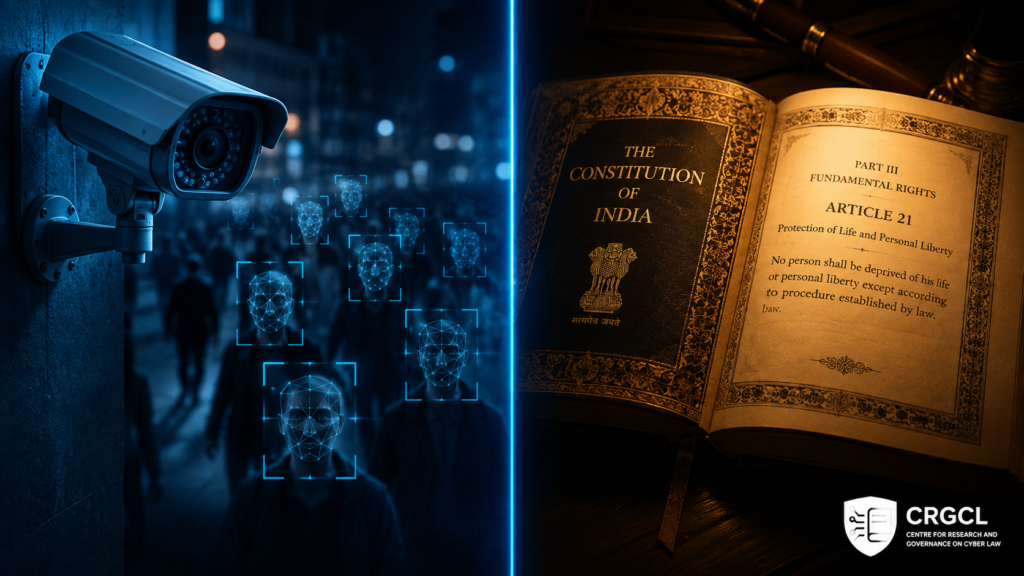
Despite the National Crime Records Bureau’s expanding Automated Facial Recognition System, no dedicated legislation governs its use. FRT threatens privacy by enabling mass, non-consensual, real-time surveillance in public spaces. Puttaswamy’s proportionality test requires that any restriction on privacy serve a legitimate aim, adopt the least restrictive means, and remain proportionate to that aim a test that generalised FRT deployment is likely to fail. The clearest illustration is the Telangana High Court public-interest litigation filed by activist S.Q. Masood, supported by the Internet Freedom Foundation, challenged the state’s unregulated FRT rollout as unconstitutional mass surveillance.
Regulatory and Data Security Frameworks
Compliance with Data Privacy Law
The Digital Personal Data Protection Act 2023 is India’s data-protection law, but its Section 17(1)(c) exemption. Covering data processing for ‘the sovereignty, integrity and security of India or prevention, detection, investigation and prosecution of any offence’. Risks being interpreted too broadly, leaving law-enforcement data processing mostly uncontrolled. A valid interpretation must require that even exempt processing meet the proportionality test; the safeguards against excessive state monitoring suggested by the Srikrishna Committee are still not in place in the current law.
Data Minimisation and Purpose Limitation
Smart-policing systems collect amounts of surveillance footage, biometric data, call logs, location data and social-media activity, making data minimisation and purpose limitation very important. While the DPDPA acknowledges these principles generally, their use in law enforcement is mostly missing. A good policy should set (a) data-retention periods that match the seriousness of the offence, (b) deletion timelines after a case is closed or a person is found not guilty, and (c) limits on sharing data between departments without judicial approval.
Liability for Systemic Errors
When an AI system creates a positive that leads to an unlawful arrest, responsibility is shared between the software developer, the agency that uses it and the officer involved. A gap that neither the Indian Penal Code nor the Bharatiya Nagarik Suraksha Sanhita, 2023 was created to fix. Using the absolute-liability doctrine from M.C. Mehta v. Union of India (1987), this article suggests that state agencies using AI tools should have liability, supported by mandatory indemnity clauses in government contracts while keeping the difference between good-faith use of a tool and its misuse.
Evidentiary Challenges and Judicial Scrutiny
A key question is whether an AI-generated risk assessment can count as the suspicion needed for a stop-and-search or the probable cause needed for an arrest under Section 41 of the BNSS. A question that neither code answers directly. American Fourth Amendment law offers guidance: in United States v. Cortez, 449 U.S. 411 (1981), the Supreme Court said that reasonable suspicion depends on the totality of the circumstances, and later studies on algorithmic policing in the U.S. Border Patrol argue that predictive results alone cannot replace that individualised confirmed judgment. Indian courts would benefit from confirmation: AI results can support other evidence, but they should not alone meet the constitutional requirement for a search or arrest.
Under Section 45 of the Bharatiya Sakshya Adhiniyam 2023, courts must consider expert opinion and AI forensic evidence should meet standards to the American Daubert standard: the method used must be peer-reviewed, its error rate must be known and shared, and the specific model must be independently examined. India’s Forensic Science Laboratories do not have this ability now; a new statutory National AI Forensic Standards Authority should be created to check AI tools used in the courts.
A Legal Roadmap for Secure Smart Policing
Before being used, every AI policing tool should go through a Fundamental Rights Impact Assessment (FRIA) based on the EU’s GDPR-based Data Protection Impact Assessment using a four-part proportionality test: a goal, suitability, necessity and strict proportionality. Crowd-surveillance FRT is likely to fail the necessity and proportionality parts, while focused FRT for finding missing people may meet all four.
The article suggests a statutory National AI Policing Oversight Authority (NAIPOA) under a new Smart Policing (Regulation and Accountability) Act. NAIPOA’s tasks should include checking AI policing tools before they are used, doing checks for bias and overuse, giving binding instructions to fix problems and keeping a public list of tools that are in use. To ensure independence, NAIPOA should be outside the Ministry of Home.
Citizen redress should be based on three things: the right to get a clear explanation of any action taken by artificial intelligence, a separate group that can hear complaints and take action and a yearly report to the parliament about how artificial intelligence is used by the police all over the country. These things will help make the right to privacy, which was talked about in Puttaswamy, a reality. They will also help people get the remedies that’re available under Articles 32 and 226.
Conclusion
To make Viksit Bharat 2047 a reality, we need to modernise the way the police work in India. We have to be careful because if we give the police too much power without checking on them, they can become a tool for oppression. The way artificial intelligence is used in policing now can hurt our constitutional rights, the way we handle data, the standards we use to decide what is true and who is responsible when something goes wrong. We need rules to make sure that artificial intelligence is used in a way that respects our rights. This means we need to look at how artificial intelligence will affect our rights. Have a group that oversees how artificial intelligence is used, makes sure that any leads found by intelligence are checked by humans and has a way for people to complain if they are treated unfairly. We cannot have a system that’s all about surveillance and forgets about the law and accountability. A good government is not measured by how it can watch its people but by how well it protects their rights.